

Vitamin C serum can be a glow-supporting powerhouse, but only when your routine lets it do its job.
So before you blame the bottle, check your order, storage, pairings, strength, and sunscreen habits.
Because sometimes, your serum is not the problem. Your routine is quietly canceling it out.
At Fix Studios, we hear this all the time: “I bought a good product, but I’m not seeing results.” And real talk? That can happen.
A Vitamin C serum may support brighter-looking skin, dullness, dark spots, and environmental stress. But it needs the right setup.
A 2023 systematic review on topical Vitamin C found benefits for concerns like photoaging and pigmentation. But those benefits depend on consistency, product quality, and smart use.
Let’s talk about the seven mistakes that may be stealing your glow.
Prefer to Watch Instead? Dr. Beth Breaks It Down on YouTube
Want the real-talk version before you read the full guide? Watch Dr. Beth explain the 7 Vitamin C serum mistakes that may be stealing your glow, including the wrong application order, storage mistakes, ingredient conflicts, and why sunscreen is still non-negotiable.
Watch the full video below, then keep reading for the step-by-step breakdown and quick fixes.
1. Applying Vitamin C Serum in the Wrong Order
This is one of the biggest routine mistakes.
A topical Vitamin C should usually go on early in your morning skincare routine. Think lightweight to heavy.
Cleanse first. Use toner if you love toner. Then apply your serum. After that comes moisturizer, then sunscreen.
Your morning order should look like this:
Cleanse → optional toner → Vitamin C serum → moisturizer → sunscreen
If you apply thick moisturizer first, you may create a barrier.That makes it harder for your serum to sit where it needs to work.
It is like putting the VIP guest outside the velvet rope. Then wondering why they never made it into the party.
Let your Vitamin C settle for about a minute before moving to moisturizer. This gives the product a better chance to absorb evenly.
Need help with product order? Use our free skincare layering guide to map out your morning and evening routine.
2. Mixing Too Many Strong Actives at Once
Skincare is chemistry. And some routines are doing way too much.
A topical Vitamin C can be wonderful in the morning. But stacking it with strong exfoliating acids, retinoids, and benzoyl peroxide in the same routine may irritate your skin.
This does not mean those ingredients are bad. It means your skin barrier may not love the group chat.
Strong actives can be helpful when used well. But when you layer too many at once, your skin may feel tight, stingy, red, or reactive.
A simple approach works better for most people:
Use Vitamin C in the morning. Use retinoids or exfoliating acids at night.

If you use both retinoids and acids, alternate evenings.
Also, let’s clear up an old myth. You may have heard that Vitamin C and niacinamide cannot be used together. That concern is outdated.
Modern, well-formulated products are often fine together. They may even complement each other for tone and brightness.
The real problem is not always the ingredient pairing. It is the total irritation load.
3. Applying It to Damp Skin When You’re Sensitive
For many hydrating products, damp skin is great. Hyaluronic acid loves damp skin. Moisturizers can work beautifully over damp skin.
But a strong Vitamin C, especially one with L-ascorbic acid, may feel spicy on damp skin.
Damp skin can increase penetration. That may sound great, but stronger is not always better.
If your skin is sensitive, reactive, or barrier-compromised, applying a potent active to damp skin can lead to stinging, redness, or irritation.
We want glow. We do not need your face sending a strongly worded email before 9 a.m.
The fix is simple.
After cleansing, pat your skin dry with a clean towel. Wait until your skin feels dry to the touch. Then apply your Vitamin C serum.
This gives you more controlled absorption. It may also lower the chance of irritation.
Effective skincare should not feel like punishment.
4. Ignoring the Packaging
Packaging matters. With some skincare products, the bottle is mostly about branding.
With a topical Vitamin C, the bottle is part of the formula story.
Vitamin C, especially L-ascorbic acid, is sensitive. Its biggest enemies are light, heat, and air.
So if your serum is in a clear bottle, sitting in bright light, and opened daily with a dropper, it may oxidize faster.
Oxidation can reduce potency. Some people may also find oxidized products more irritating.
If your serum turns dark orange or brown, that is your skincare giving two weeks’ notice. Very polite. Very official. Very much time to replace it.
Look for dark or opaque packaging. An airless pump is even better.
At Fix Studios, one option we love is LustraCe™ CE + GTP Antioxidant Radiance Serum. It features a 20% Vitamin C complex and is designed to support antioxidant radiance, dullness, discoloration, and oxidative stress concerns.
But whichever Vitamin C serum you choose, stability matters.
A great formula still needs protection.

5. Storing It Where Heat, Light, or Humidity Can Reach It
Let’s be precise. Your bathroom is not automatically the villain. The real issue is exposure.
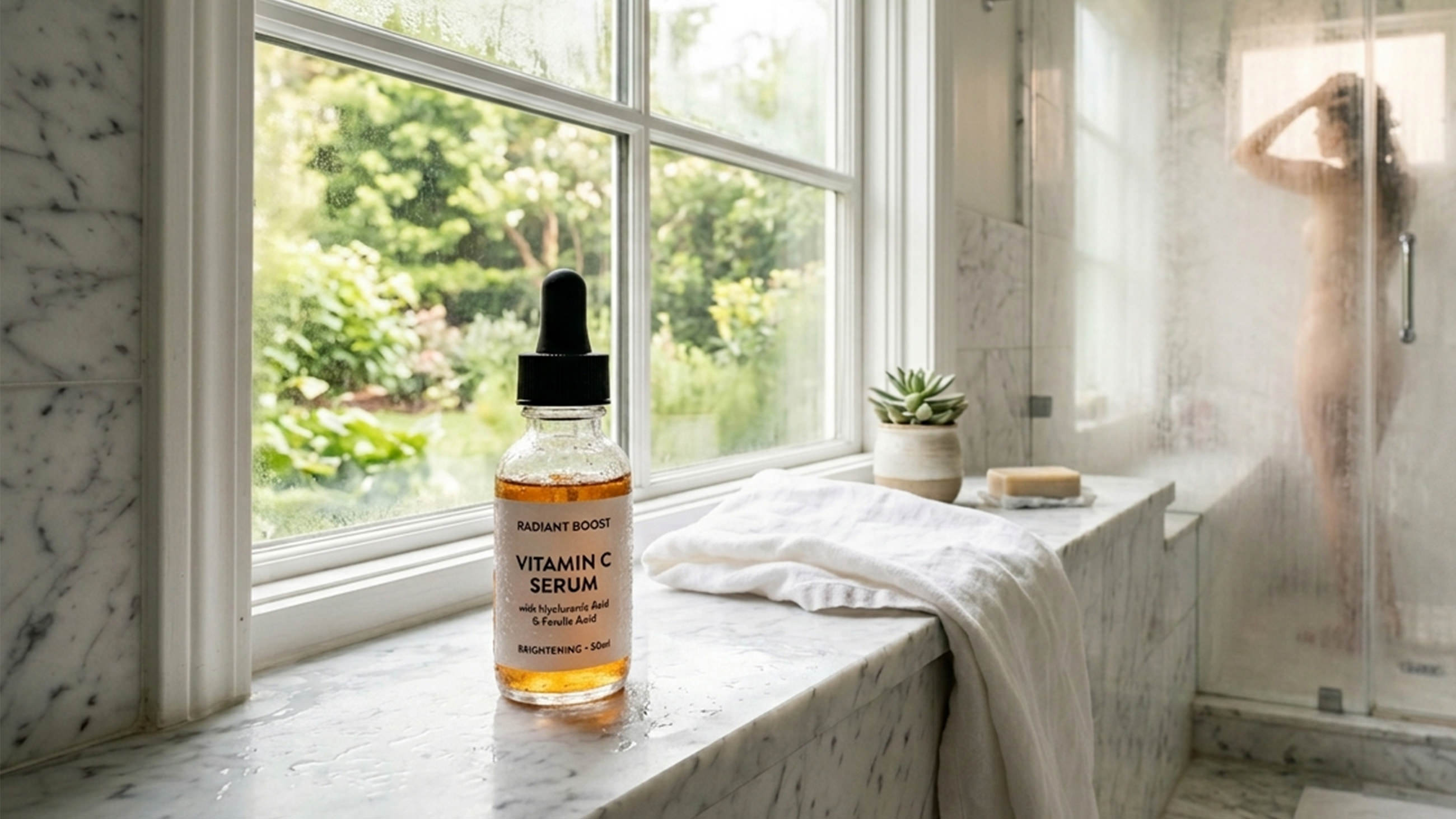
If your Vitamin C serum lives on the bathroom counter, near a sunny window, or beside shower steam, that is not ideal.
That is a tiny tropical vacation your Vitamin C never requested.
But a closed vanity drawer may be perfectly fine. A bedroom drawer can also work. A cabinet away from heat and light can work too.
The rule is simple:
Cool. Dry. Closed. Dark.
That is what you want.
Vitamin C formulas can be sensitive to heat, light, air, and moisture. So do not think, “Never bathroom.” Think, “Is this spot protecting the formula?”
A closed drawer is different from a steamy counter.
If your product recommends refrigeration, follow the label. If you live somewhere very warm, refrigeration may help certain formulas.
But always follow the product instructions first.
A topical Vitamin C should work hard on your skin. It should not have to survive a sauna first.
6. Using the Wrong Type or Strength
Not all Vitamin C is created equal. And stronger is not always smarter.
The most researched form is L-ascorbic acid. It can be very effective, but it may also sting more.
This is especially true when the formula is strong, low-pH, or used on irritated skin.
A classic absorption study on topical L-ascorbic acid found it needed to be formulated below a pH of 3.5 to enter the skin. The study also found absorption maxed out around 20%.
Translation? More is not always better.
At some point, your skin is standing there with a clipboard saying, “We have reached capacity.”
For many people, 10% to 20% can be an effective range. But if you are new to Vitamin C, start lower. If your skin is sensitive, start lower.
If your barrier is already irritated, stop and repair first.
You can also consider more stable Vitamin C derivatives, such as:
| Vitamin C Type | Why It May Help |
| L-ascorbic acid | Most researched, but can sting |
| 3-O-ethyl ascorbic acid | Often more stable and tolerable |
| Sodium ascorbyl phosphate | Gentler option for some skin types |
| Tetrahexyldecyl ascorbate | Oil-soluble and often well tolerated |
The best Vitamin C is not always the strongest one. It is the one your skin can use consistently without getting angry.
Consistency beats intensity. Every time.
7. Skipping Sunscreen
This is the non-negotiable. A Vitamin C serum is not sunscreen.
It does not block UV rays. It does not replace SPF.
Skipping sunscreen while using Vitamin C is like carefully whitening your sneakers, then mowing the lawn in them. Technically, you tried. But the grass had other plans.
Vitamin C can support antioxidant defense. But sunscreen helps protect your skin from UV damage in the first place.
That matters for dark spots, dullness, uneven tone, and signs of photoaging.
The American Academy of Dermatology recommends broad-spectrum sunscreen with SPF 30 or higher. They also recommend reapplying every two hours when outdoors, or after swimming or sweating.
So here is your morning duo:
Vitamin C serum + broad-spectrum SPF
That pairing makes sense.
Vitamin C supports your skin against environmental stress. Sunscreen helps protect the progress you are trying to make.
SPF may not feel glamorous. But it saves the glow.
How to Build a Better Morning Routine
A great routine does not need to be complicated. It needs to be consistent.
Here is a simple morning setup:
| Step | Product |
| 1 | Gentle cleanser |
| 2 | Optional toner |
| 3 | Vitamin C serum |
| 4 | Moisturizer |
| 5 | Broad-spectrum SPF 30+ |
That is it. No 14-step routine. No chemistry degree. No emotional support sunscreen.
Well… maybe a little emotional support sunscreen.
If you are building a routine from scratch, start with the basics. Cleanse, treat, hydrate, protect.
Then adjust based on how your skin responds.
A topical Vitamin C should fit into your routine. It should not make your skin feel stressed, tight, or inflamed.
When to Pause Vitamin C
Sometimes the best move is to take a break.
Pause your Vitamin C if your skin is burning, peeling, inflamed, or unusually reactive. This may be a sign your skin barrier needs support.
Focus on gentle cleanser, moisturizer, and sunscreen for a few days. Skip exfoliating acids and retinoids while your skin calms down. Then reintroduce actives slowly.
If irritation keeps happening, the formula may be too strong. Or it may not be the right type for your skin. That is where professional guidance helps.
At Fix Studios, we look at your skin, your routine, your goals, and your tolerance. Then we help you choose products that make sense.
Not just what is trending.
You can shop our medical-grade skincare collection or book an appointment for personalized recommendations.

Vitamin C Serum FAQ
| Question | Answer |
| Can I use Vitamin C serum every day? | Many people can use it daily, especially in the morning. Sensitive skin may need to start slowly. |
| Should Vitamin C serum go before moisturizer? | Yes. In most routines, apply it after cleansing and before moisturizer. |
| Can I use Vitamin C with retinol? | Many people do better using Vitamin C in the morning and retinol at night. |
| Is Vitamin C serum good for dark spots? | It may support brighter, more even-looking skin, especially when paired with daily sunscreen. |
| How do I know if Vitamin C has oxidized? | A dark orange or brown color may suggest oxidation, especially with L-ascorbic acid formulas. |
| Where should I store Vitamin C serum? | Store it somewhere cool, dry, closed, and dark. A closed drawer or cabinet may be fine. |
| Does Vitamin C replace sunscreen? | No. Vitamin C is not SPF. Use broad-spectrum sunscreen every morning. |
The Bottom Line: Small Fixes Can Save Your Glow
A topical Vitamin C can be a beautiful part of your skincare routine. But the details matter.
Use the right order. Do not stack every strong active at once. Apply to dry skin if you are sensitive. Check the packaging. Store it well. Choose the right strength. And please, do not skip sunscreen.
Your skin does not need more chaos. It needs a routine that makes sense.
When your products are used in the right order, at the right strength, and with daily SPF, your Vitamin C serum has a better chance to support the brighter, healthier-looking glow you bought it for.
Disclaimer
This article is for informational purposes only and should not be considered medical advice. Results vary from person to person. Always consult with a qualified provider before starting any treatment.



Share:
Lumecca IPL Cincinnati Mason: 5 Skin Changes to Expect After IPL
7 Retinol Mistakes That Can Damage Your Skin Barrier