

Retinol mistakes usually happen before the first application ever touches your face.
It is not always that retinol is “too harsh.” More often, people start the wrong retinoid, at the wrong strength, on the wrong schedule. Then their skin gets red, flaky, tight, and irritated.
And of course, retinol gets blamed.
Here’s the real talk: retinol can be a beautiful ingredient when it is used well. It can help improve the look of fine lines, uneven tone, rough texture, and dullness over time. But your skin barrier needs to be part of the plan.
In this guide, we’ll cover:
- Why stronger retinol is not always better
- The difference between retinol vs retinal
- How to start retinol without overwhelming your skin
- How the retinol sandwich method works
- When to pause and ask for guidance
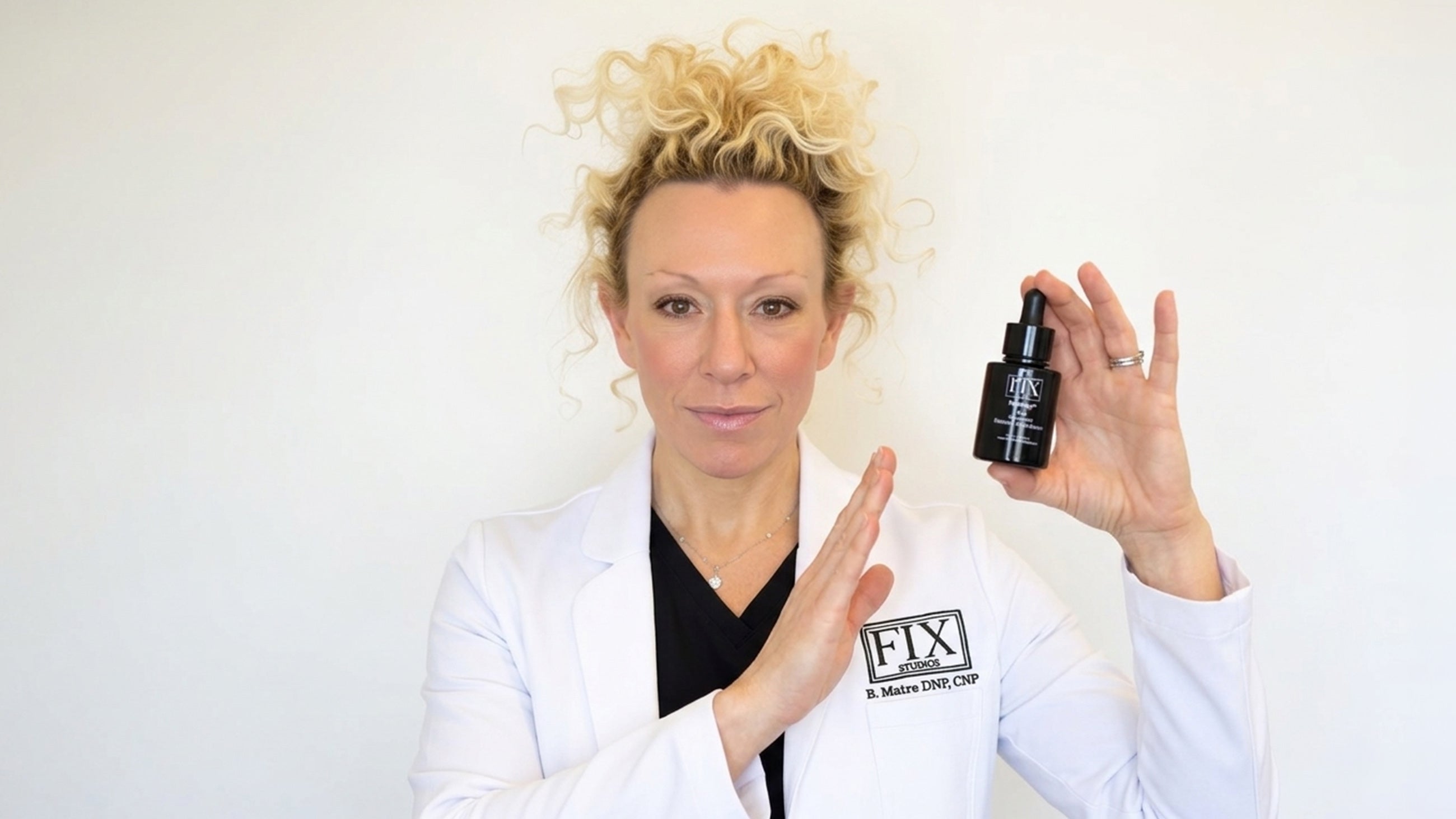
Prefer to watch Dr. Beth explain it first? Here's a quick video breaking down the biggest retinol mistakes, how to choose the right retinoid, and how to start without making your skin barrier angry.
Watch it below, then keep reading for the full guide.
Retinol Mistake #1: Thinking Stronger Always Means Better
This is one of the biggest retinol mistakes we see.
Someone hears retinol is good for aging skin. Then they buy the strongest product they can find.
The thought process makes sense. “If a little works, more must work better.”
Except skin does not always play by that rule. Your face is not asking for a strength contest. It is asking for consistency, support, and time.
The American Academy of Dermatology explains that retinoids can be useful for mild acne, pigmentation irregularities, fine lines, and wrinkles. But their guidance also supports starting with the least-intense option and building slowly.
That is the part many people skip.
They jump straight to “advanced” before their skin has basic tolerance.
A smarter approach? Start lower. Use less. Go slower.
Lower strength plus consistency beats aggressive use almost every time.
Retinol Mistake #2: Not Knowing Retinol vs Retinal
Let’s clear up the retinol vs retinal confusion.
“Retinoid” is the umbrella term.Under that umbrella, you’ll find several forms of Vitamin A used in skincare.
Think of it like a ladder:
Retinyl esters are usually the gentlest.
Retinol is the classic over-the-counter middle ground.
Retinal, also called retinaldehyde, is one step closer to the active form.
Retinoic acid, like tretinoin, is the active prescription form.

Here is the simple version.
The more conversion steps a retinoid needs, the gentler it usually is.
The fewer conversion steps it needs, the stronger it may feel on your skin.
That does not mean retinal is bad. It can be a great option for the right person.
In fact, a randomized controlled trial on retinaldehyde found that 0.05% and 0.1% retinaldehyde creams were well tolerated and improved hydration and texture. The 0.1% cream also improved melanin index.
But “well tolerated” in a study does not mean every face should jump in aggressively.
Your skin history still matters. If you are brand new or sensitive, retinol for beginners usually means starting gently.
If you have already used retinol well, retinal may be a thoughtful next step.
Retinol Mistake #3: Starting Too Many Nights Per Week
This is where many routines go from “I’m being proactive” to “why is my face peeling?”
Retinoids do not need to be used nightly at first. Especially if you are new.
A good beginner schedule may look like this:
- Start one to two nights per week.
- Stay there for a couple of weeks.
- If your skin feels calm, move up slowly.
- Then consider every other night as tolerated.
The AAD’s retinoid guidance includes using the least-intense formula and starting every other night.
At Fix Studios, we like a conservative mindset for retinol for beginners.
Your skin does not need to be “humbled.” It needs to be trained.
With Refinity™ Advanced Retinoid Night Serum, our guidance is to begin two to three times per week, then increase to every other day as tolerated. Very sensitive or brand-new users can start even slower.
That is not weakness. That is smart skincare.

Retinol Mistake #4: Using Too Much Product
A pea-sized amount is enough for the whole face.
Not a lima bean. Not a grape. Not a “my skin is expensive and I want results by Friday” scoop.
A pea-sized amount.
Using more retinol does not make it work faster. It usually makes your skin more irritated. This is one of those retinol mistakes that feels small but matters a lot.
More product can mean more redness, more dryness, and more flaking.
Your face is not a baked potato. You do not need to load it up.
Apply a small amount across the face, avoiding the delicate corners of the nose, mouth, and eyes unless your provider gives different directions.
Then moisturize. Your future skin barrier will thank you.
Retinol Mistake #5: Skipping the Retinol Sandwich Method
The retinol sandwich method is one of the easiest ways to make retinoids feel more manageable.
It is simple:
- Moisturizer first.
- Pea-sized retinoid second.
- Moisturizer again.
That’s it.

This method creates a little buffer between your skin and the retinoid. It can help reduce dryness and discomfort while your skin adjusts.
The retinol sandwich method is especially helpful if:
- You are new to retinol.
- Your skin is dry or sensitive.
- You are stepping up to a stronger product.
- You have had irritation before.
- You want to protect your retinol skin barrier.
Does buffering make your retinoid useless? No.
It may simply make the process more comfortable. And comfort matters.
Because if your routine makes your face sting every night, you probably will not stick with it. Consistency wins.
Retinol Mistake #6: Forgetting SPF During the Day
Retinoids belong at night. SPF belongs in the morning. This is non-negotiable.
The AAD notes that retinoids can make skin more sensitive to the sun. Their guidance includes nighttime use and sun protection during the day.
That does not mean you should fear retinol. It means you need the right routine around it.
Use your retinoid at night.
In the morning, cleanse gently if needed, moisturize, and apply sunscreen.
If you are serious about retinol, you need to be serious about SPF. Otherwise, you may be working against your own progress.
At Fix Studios, we often say skincare is not one product. It is a plan. A retinoid without daily sun protection is not much of a plan.
Looking for supportive daily products? You can shop our medical-grade skincare collection or ask us what fits your skin during your next visit.


Retinol Mistake #7: Ignoring Your Skin Barrier
Your skin barrier is the outer protective layer of your skin. When it is happy, your skin tends to feel calmer, smoother, and more resilient.
When it is irritated, you may notice:
- Redness
- Flaking
- Burning
- Stinging
- Tightness
- Dry patches
- Sudden sensitivity
Here’s the part people miss. Irritation is not proof your retinol is working better.
Usually, irritation is proof you asked too much from your skin too fast.
This retinol skin barrier connection matters. If your barrier is already stressed, adding more actives may make things worse.
That means you may need to pause retinol if your skin is sunburned, freshly waxed, peeling, or irritated from other products.
You may also need extra guidance if you use acne prescriptions, exfoliating acids, benzoyl peroxide, or strong in-office treatments.
And if you are pregnant or trying to conceive, this is not the time to experiment with retinoids.
The American Academy of Dermatology’s pregnancy skincare guidance recommends avoiding prescription and over-the-counter products with retinoids during pregnancy.
That includes retinol and adapalene.
Speaking of adapalene, let’s clear up another common mix-up.
Adapalene 0.1% is an over-the-counter retinoid option for acne. The FDA’s review supports Differin Gel 0.1% for OTC acne treatment.
That does not mean adapalene is the default anti-aging starter for everyone. We think of adapalene as more of an acne-path retinoid.
For aging concerns, texture, tone, and beginner tolerability, your best starting point may be different.
That is why personalized guidance matters.
How to Start Retinol the Smart Way
The smartest way to start retinol comes down to three things.
Type. Strength. Schedule.
Those three words can save your skin a lot of drama.
Choose the right type for your skin. Pick a strength your skin can tolerate. Use a schedule that builds gradually.
If you are brand new, do not overcomplicate it. Start one to two nights per week. Use a pea-sized amount. Try the retinol sandwich method. Wear SPF every morning.
Do not stack five strong actives on the same night. And please, do not keep pushing through burning.
Your skin is allowed to have boundaries.
If you are not sure how to start retinol, or if your current routine feels chaotic, a consultation can help.
At Fix Studios, we build skincare plans around your skin, not around TikTok trends.
And if your routine has too many steps, too many actives, or too many mystery products, we can help simplify it.
You can also use our free skincare layering guide if you want help understanding what goes where.
FAQ: Retinol Mistakes and Skin Barrier Questions
| Question | Answer |
| What are the most common retinol mistakes? | The most common retinol mistakes include starting too strong, using it too often, applying too much, skipping moisturizer, and forgetting daily SPF. |
| Is retinol good for beginners? | Yes, but retinol for beginners should start slowly. A gentle schedule is usually better than jumping into nightly use. |
| What is the retinol sandwich method? | The retinol sandwich method means applying moisturizer first, then retinol, then moisturizer again. It helps buffer irritation. |
| What is the difference between retinol vs retinal? | Retinal is one conversion step closer to retinoic acid than retinol. It may work faster, but it can feel stronger for some skin types. |
| How often should I start retinol? | Many beginners do well with one to two nights per week, then slowly increasing as tolerated. |
| Can retinol damage the skin barrier? | Retinol can irritate the skin barrier when used too aggressively. Slow use, moisturizer, and SPF can help support tolerance. |
| Should I use retinol while pregnant? | Retinoids should generally be avoided during pregnancy. Talk with your own qualified provider for personal guidance. |
Final Thoughts: Retinol Mistakes Are Avoidable
Retinol mistakes do not mean your skin failed. They usually mean your routine needs a better plan.
The goal is not the strongest product. The goal is the right product, used the right way, at the right pace.
When your retinol routine supports your skin barrier, you give your skin a better chance to look smoother, brighter, and more refined over time.
And that is what we want. Not flaky drama. Not red, angry skin.
Just a smart, clinically guided routine that makes sense for you.
Disclaimer
This article is for informational purposes only and should not be considered medical advice. Results vary from person to person. Always consult with a qualified provider before starting any treatment.


Share:
7 Vitamin C Serum Mistakes That Are Stealing Your Glow
How to Use Benzoyl Peroxide Without Wrecking Your Skin Barrier